
Why AI is Standardizing the Web: The Crucial Importance of Web Designers for Your Branding
Open ten AI-generated websites side by side. Light background, rounded fonts, a large hero image, and a "Our Values" section with three floating icons. Do you feel like you’re looking at the same site ten times? It’s not a coincidence. It’s a direct consequence of how AI functions—and it’s why every entrepreneur who cares about their brand should be concerned.
Key Statistics:
53% of mobile site visits were abandoned if pages took longer than 3 seconds to load.
Source : Google, "The Need for Mobile Speed", 2016
38% of users will stop engaging with a website if the layout or content is unattractive.
Source : Adobe, "The State of Content", 2015
75% of credibility judgments are based on a website's visual presentation.
Source : Fogg et al., Stanford Web Credibility Project, 2002 — credibility.stanford.edu
1. Why Do AI-Generated Sites All Look the Same?
To understand this phenomenon, we must first understand how artificial intelligence creates. It doesn’t think. It doesn’t feel. It predicts.
Technically, an AI website generator has been trained on millions of existing pages. It analyzes what is "statistically most frequent": which colors appear often, which layouts are common, and which fonts are used most.
From there, it produces a synthesis of everything it has seen.
In practice: When you ask an AI to "create your website," it’s not creating your site. It’s creating the average site for your industry, with average colors, average fonts, and average animations. This isn’t creativity; it’s statistical regurgitation.
Designers and UX experts have even named this phenomenon: "Algorithmic Beige." Pastel backgrounds, soft sans-serif fonts, and standard scroll animations. You’ve seen it before, and after the tenth time, you stop noticing it. According to a 2025 study by EY, users are developing "predictable blindness"—when a site looks like everyone else's, the eye fails to engage. It becomes invisible
Source : EY, "Generative AI in Transition", 2025
In February 2025, designer Ved (Design Bootcamp) published an experiment on Medium: he gave the same prompt to three different AI tools—Bolt, Lovable, and Replit. The result? Three nearly identical designs. His conclusion: "AI doesn't make creative decisions; it simply chooses the statistically most effective design." Without a logo, you wouldn't know which site belongs to which company.
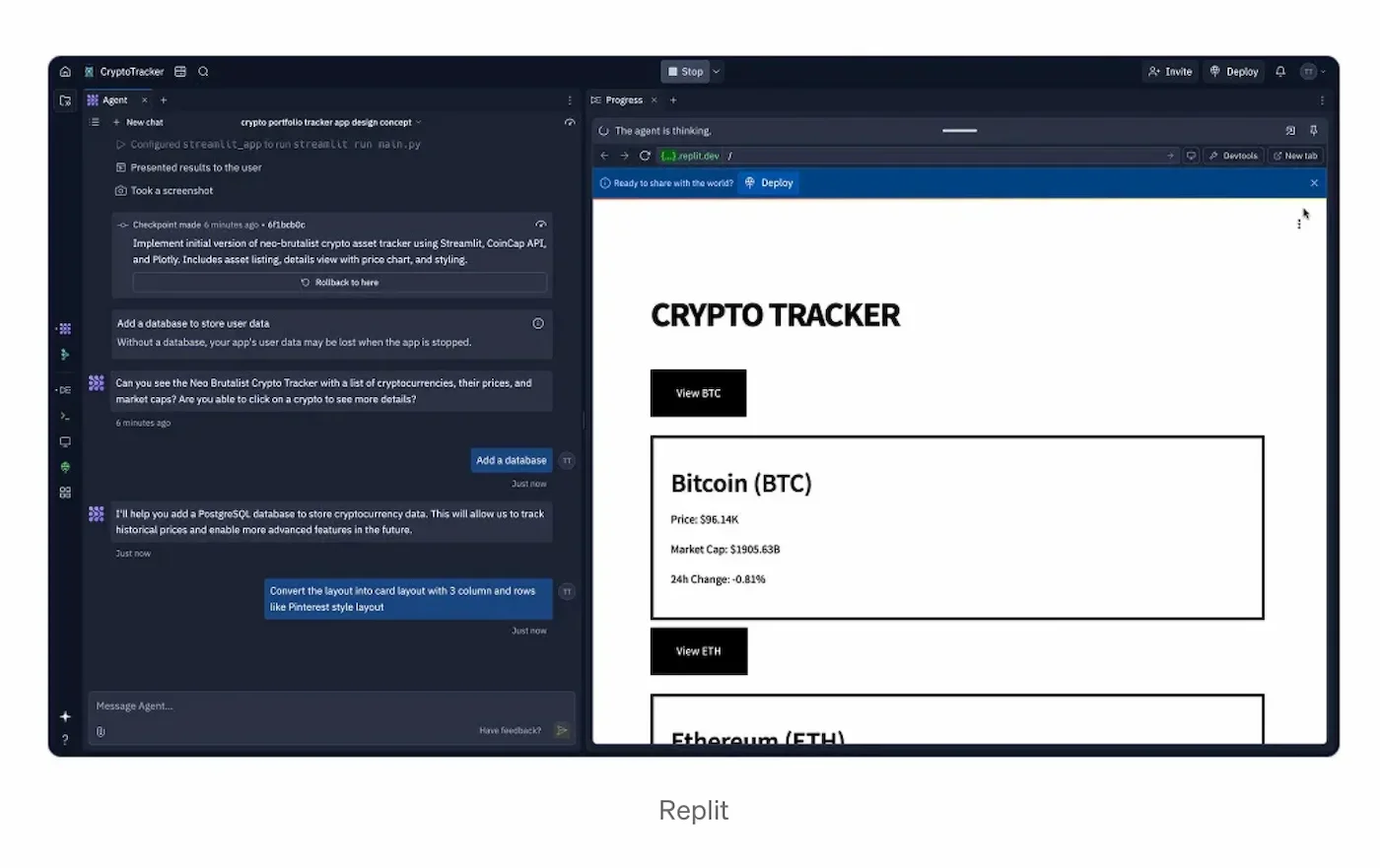
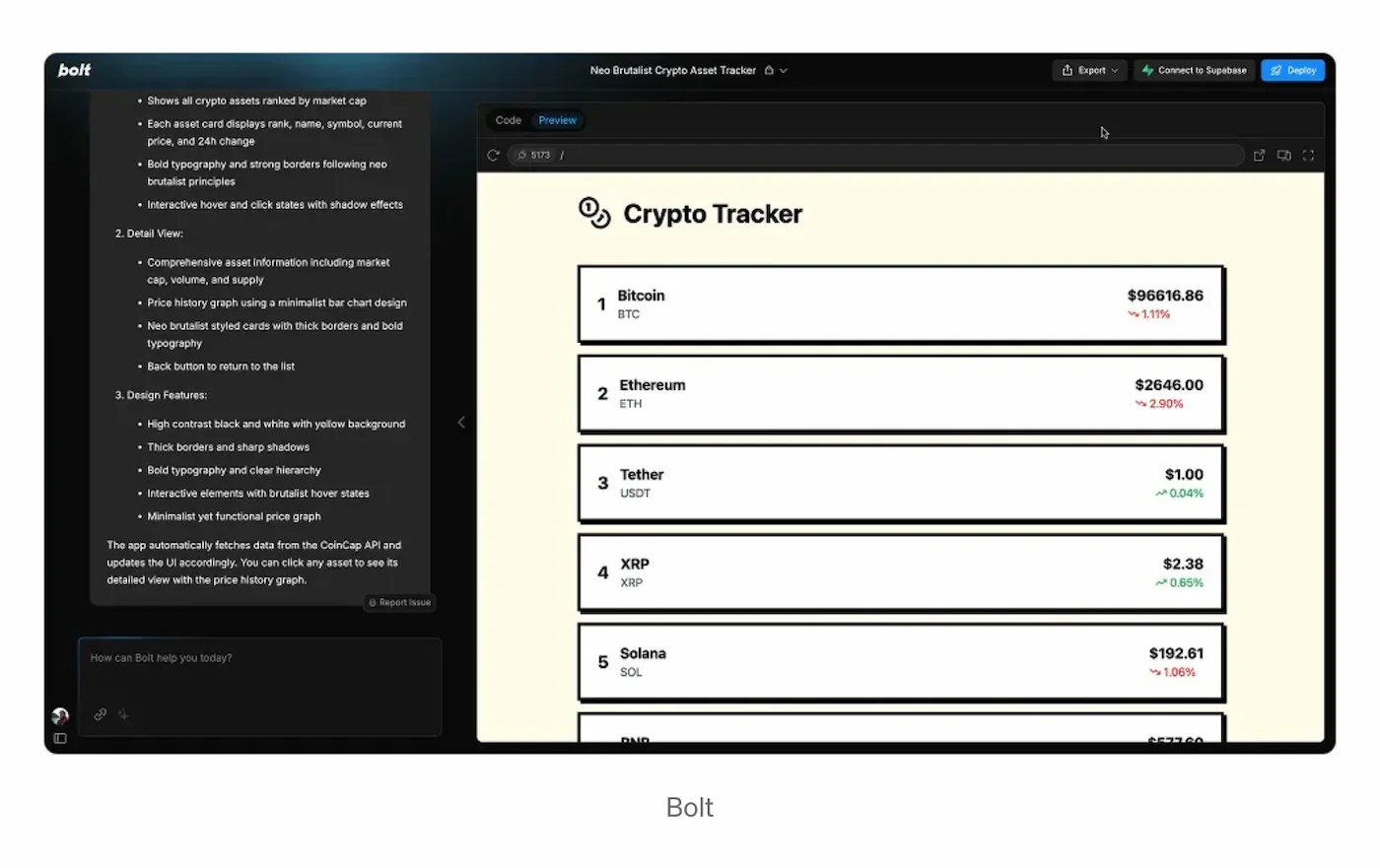
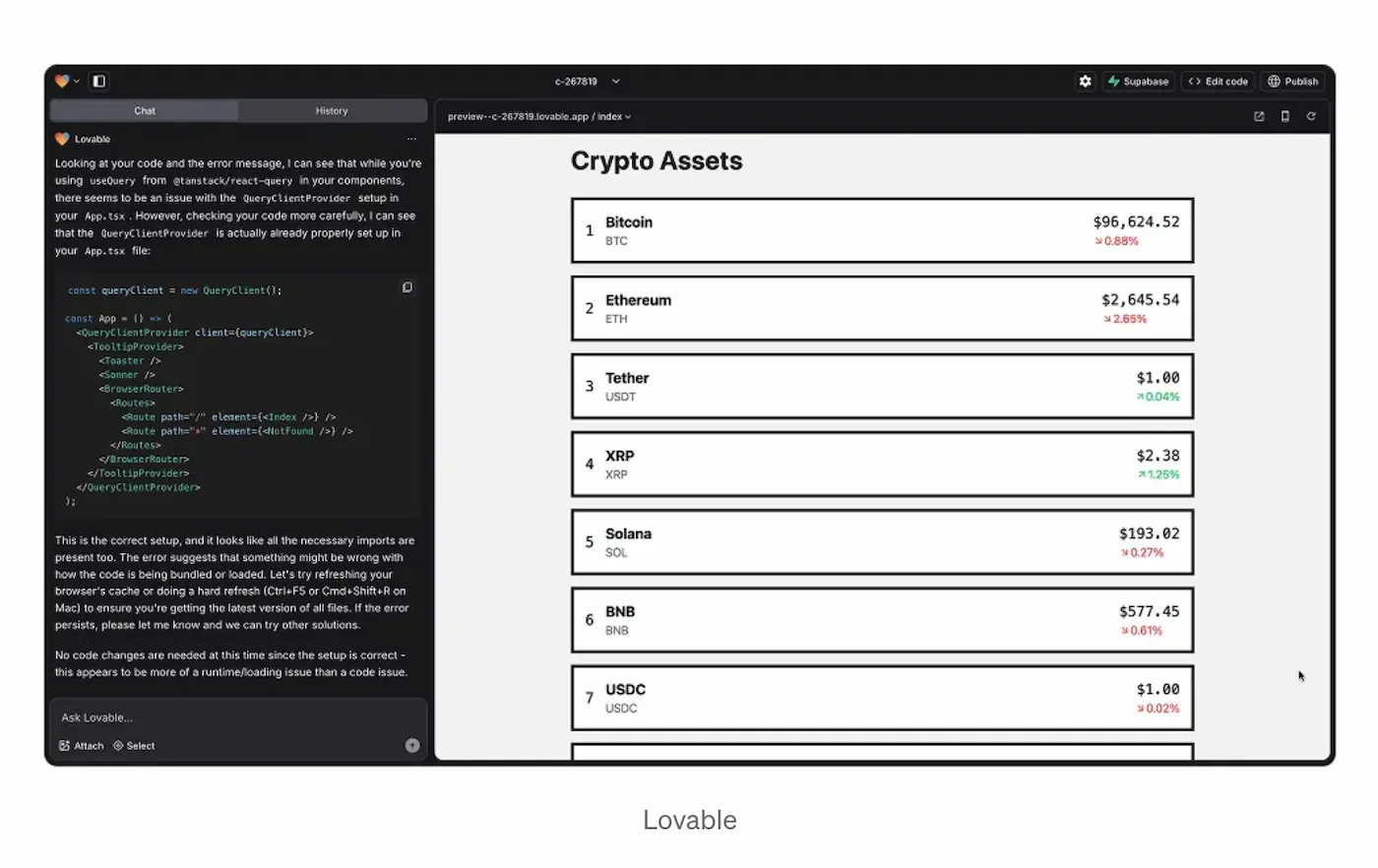
Source : Ved, Medium / Design Bootcamp, 16 février 2025
2. What Exactly is Branding? (And Why AI Can’t Do It)
Many people confuse "branding" with a "logo." In reality, branding is the sum of emotions, impressions, and associations people have with your business. It’s what makes a brand recognizable before you even read its name.
Think of Apple: simplicity, purity, exclusivity. Think of Harley-Davidson: freedom, authenticity, rebellion. These universes didn't happen by chance. They are the result of human, strategic, and often counter-intuitive creative decisions.
A professional web designer starts with questions AI never asks:
Who are you, really?
What is your story?
How do your best clients feel when they work with you?
What emotion do you want to trigger in 5 seconds?
Based on these answers, a designer builds a coherent, unique, and memorable visual universe. AI, on the other hand, starts with a template.
3. AI Follows the Rules. A Designer Knows When to Break Them.
In UX, there is a well-known rule called Jakob’s Law (named after researcher Jakob Nielsen). It states that users prefer your site to work the same way as all the other sites they already know, as it reduces the cognitive effort needed to navigate.
AI applies this law to the letter. It always creates familiar, predictable, and comfortable sites. In theory, that's good. In practice, in a market where everyone is doing the same thing, being predictable makes you interchangeable.
Source : Nielsen, J., "Jakob's Law of Internet User Experience", Nielsen Norman Group, 2000 — nngroup.com/articles/end-of-web-design
AI-generated website:
Follows 100% of conventions
Average industry design
Functional but soulless
Identical to the competition
Ready in minutes
Built for no one in particular
Website designed by a web designer:
Knows when to break the rules
Unique identity for your brand
Emotion and memorability
Strong competitive differentiator
Thoughtful, strategic, lasting
Built specifically for your clients
4. Your Website is Not a Brochure. It’s Your Top Salesperson.
As established by Stanford research, 75% of a website's credibility is judged by its visual design. This means your site is often the first "employee" a prospect meets. If this employee looks exactly like those of your three direct competitors, why would a prospect choose you?
Research published on ResearchGate regarding the "Dead Internet Theory" suggests that the homogenization of digital spaces by algorithms creates a diffuse loss of trust among users. People feel—even subconsciously—that they are facing something generic and mass-produced. That impression transfers directly to your brand.
Key takeaway: A site that looks like all the others doesn't say "we are professional." It says "we are just like everyone else." In a competitive market, being like everyone else is the worst position to be in.
5. AI is a Fantastic Tool. But It’s a Tool, Not a Pilot.
At AIMOPS, we aren't against Artificial Intelligence. We use it daily and believe it can be extraordinarily useful in the web creation process. But the key is understanding at which stage it intervenes.
What AI does very well:
Accelerating repetitive tasks (image resizing, generating base mockups).
Optimizing code for faster loading speeds.
Suggesting base copy from a brief.
Improving web accessibility in real-time.
What AI cannot do:
Understand what makes your business unique.
Feel the emotion you want to convey.
Decide if your brand should be austere or warm and accessible.
Imagine a layout that has never existed before.
6. The Real Risks of Delegating Everything to AI
The Invisible Site: You have a "correct," functional site, but no one remembers it. Your conversion rate stagnates because the site lacks emotional impact.
The Interchangeable Site: A prospect compares you to a competitor. Both sites were AI-generated. They look so similar that the prospect chooses based on the only thing they can differentiate: price. You’ve lost before you even showed your value.
The Stagnant Site: Automatically generated sites are hard to evolve coherently. Without a human-designed system, every addition creates visual inconsistencies.
Conclusion
The standardization of the web by AI is real, documented, and accelerating. In this context, originality is no longer a luxury: it is your primary competitive advantage. AI can create a site in minutes. A web designer can create your site—the one that reflects who you are and why clients should choose you over anyone else.
Thinking about building a website for your business?
AI tools can certainly be an interesting starting point. However, if your goal is to create a site that clearly communicates your services, supports your operations, and actually converts visitors into clients, collaborating with an expert can make the task significantly easier.
At AIMOPS, our goal isn't just to "build a website." We aim to create a strategic tool that aligns with your business reality—from brand messaging to structure, features, and technological integrations.
👉 Discover how AIMOPS approaches web development and strategy to propel your business.
Sources & References
Google, "The Need for Mobile Speed", 2016 — 53 % des visites mobiles abandonnées si chargement > 3 sec. — think.withgoogle.comAdobe, "The State of Content", 2015 — 38 % des utilisateurs quittent un site au contenu ou à la mise en page peu attrayant. — adobe.comFogg, B.J. et al., Stanford Web Credibility Project, 2002 — 75 % des jugements de crédibilité basés sur la présentation visuelle. — credibility.stanford.eduNielsen, J., "Jakob's Law of Internet User Experience", Nielsen Norman Group, 2000 — Les utilisateurs préfèrent que votre site fonctionne comme ceux qu'ils connaissent. — nngroup.com/articles/end-of-web-designEY Switzerland, "AI-Generated Content in Transition – Between Progress and Fatigue", 27 février 2025Lien direct :https://www.ey.com/en_ch/newsroom/2025/02/ey-position-paper-ai-generated-content-in-transition-between-progress-and-fatigueMuzumdar, P., Cheemalapati, S., RamiReddy, S.R., Singh, K., Kurian, G. & Muley, A. (2025). "The Dead Internet Theory: A Survey on Artificial Interactions and the Future of Social Media". Asian Journal of Research in Computer Science, 18(1), pp. 67–73.DOI :https://doi.org/10.9734/ajrcos/2025/v18i1549 Aussi disponible sur arXiv :https://arxiv.org/abs/2502.00007 Aussi sur ResearchGate :https://www.researchgate.net/publication/387764031Bandara, C., "Why every website on the internet looks the same", UX Collective — Tension entre familiarité (Loi de Jakob) et différenciation visuelle. — uxdesign.cc8. Ved, "I Asked 3 AI Tools to Design a Website, and They All Gave Me the Same One", Medium / Design Bootcamp, 16 février 2025 — Test comparatif de Bolt, Lovable et Replit sur un même prompt : les trois outils ont produit des mises en page, palettes de couleurs et choix typographiques quasi identiques. — medium.com/design-bootcamp/i-asked-3-ai-tools-to-design-a-website-and-they-all-gave-me-the-same-one-82be1246dd7f